This blogpost is a companion to the exhibit case of the same name that went up on display in the Dalnavert’s attic in January 2026. This article can be enjoyed without viewing the exhibit, as there are photos of the artifacts throughout the post.
Written by Charlotte McGregor, Collections and Curatorial Intern
The Victorian Curio Cabinet has its roots in a much deeper tradition. The 19th Century “Curio Cabinets” were a middle-class fad, and miniatures of a much older tradition. They are an interpretation of the “Rooms of Wonder” or “Wunderkammer” which were a trend with the wealthy in Europe starting in the 16th century. They were popular into the 17th and 18th centuries, and are the precursor to the modern museum. Their purpose was not just to show off rare, expensive or unique items, but to be used in scholarship to learn about the natural world, history, and other countries.
“Cabinets of Wonder” are intrinsically tied to colonialism and conquest. Items that ended up in the collections of wealthy and influential Europeans were most often stolen from their cultures of origin. Today, modern museums are working to acknowledge these wrongs and sometimes return these items. This process is called repatriation.
The items in this Curio Case are all items in the Dalnavert Museum’s permanent collection. These objects came to be artifacts in our museum through donation, inter-institutional gift, or as an acquisition.
Today, we recognize that Dalnavert Museum has a direct responsibility to promote reconciliation. We strive to follow the recommendations put forward by the Canadian Museums Association in Moved to Action: Activating UNDRIP in Canadian Museums. This report was a direct response to answer the Truth and Reconciliation Commission's Call to Action #67.
1. Teddy Bear c.1920s. Metal, Fabric, and Glass. Nuremberg, Germany 980.1.4a-c
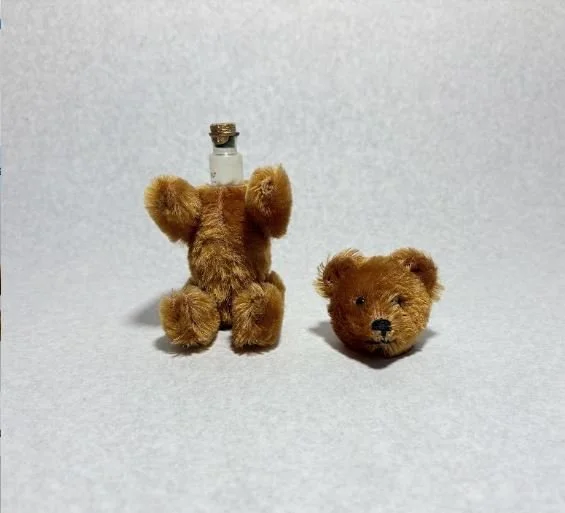
This miniature teddy bear hides a secret perfume bottle. Manufactured by the German Company Schuco (Schreyer and Company) starting in 1924, these “Piccolo” bears were given out as free promotional items until the 1970s. This particular bear is most likely from the 1920s or 1930s.[1]
2. Roller Skates c.early 1900s. Leather and Metal. Canada 017.1.16a-b
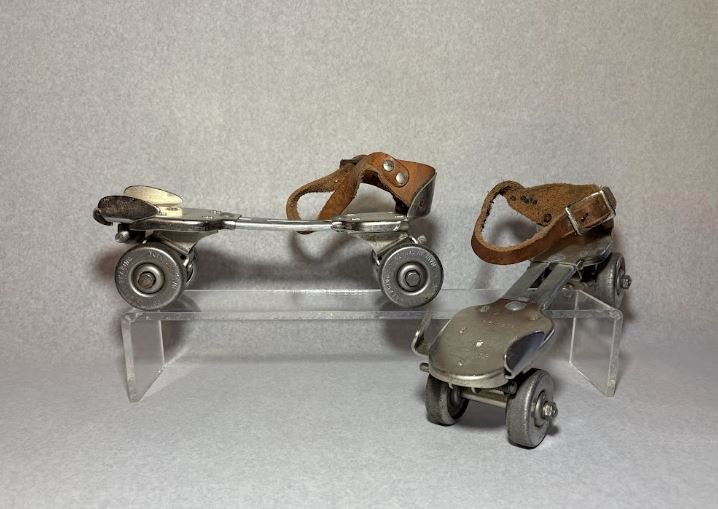
The first roller skates were purportedly invented by Joseph Merlin in 1760, where he wore them to a dinner party. Modern roller skates - like these ones - were developed by James Plimpton of New York in 1863. They allowed the wearer to easily turn, as the wheels rotated on the sole of the skate. This set off a skating craze, and by the 1870s many cities across North America had indoor skating rinks.[2] The Winnipeg Roller Rink opened at Portage and Langside in 1912. It was renamed Galaxy Roller Rink before its closure in 2007. [3]
“The roller skating rink is fast becoming a popular place of amusement. There was a large and fashionable assembly there last evening and those who did not try the rollers amused themselves by looking on. The band was present and its sweet strains added greatly to the enjoyment of the evening.”
Winnipeg Free Press, November 5, 1884, page 4 [4]
These skates belong to Dalnavert’s permanent collection. They are to be worn over shoes and can be adjusted to fit multiple sized feet, though the key is missing. They are made of steel and have leather straps, on which someone has written “Hilary Carter”.
3. Whimsey c.1890. Blown Glass. Ireland 979.1.1
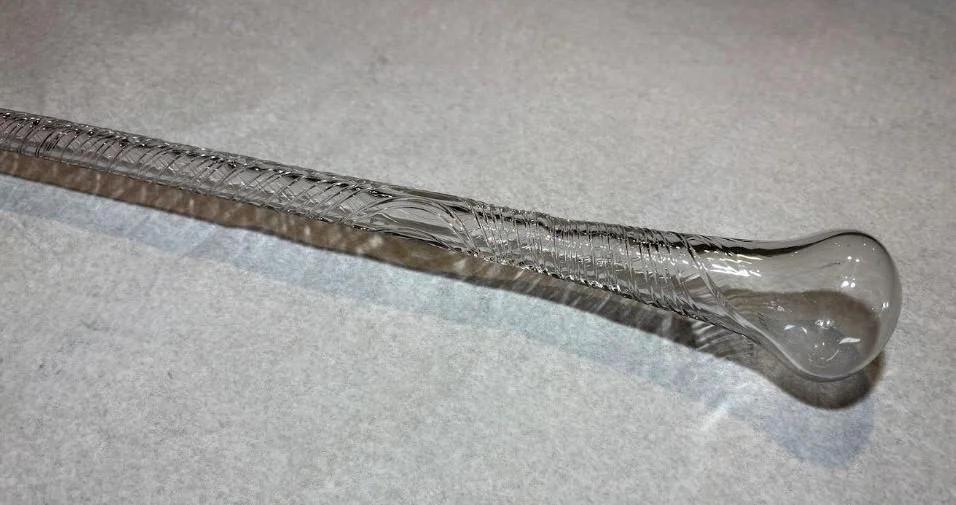
Maybe the most peculiar item in this case, this object was brought over from Ireland in the 1890s by a woman named Susan Prey (née Norris). It was thought to be a “witching wand” that was used to ward off evil spirits by her granddaughter who donated it. This whimsey is 115 cm long, and looks like it could be used as a walking stick.
Whimsies, also called “End-of-Days”, were made by glass blowers in the 18th and 19th centuries at the end of their shifts. Whimsies were made from leftover glass and took many shapes: chains, rolling pins, top hats, paperweights and canes, amongst others. These objects were made to show off a glassblower’s skill, to help them blow off steam after a long shift, or merely for fun. These items were made on a whim, hence the name.
Glassworkers carried these items with them during Labor Day parades to show union pride and worker solidarity. Whimsies were thought to keep away evil, and were hung above doorways in homes and pubs across the United Kingdom. [5]
4. Mustache Cup c. 1880-1900s. Porcelain. Germany 995.5.1
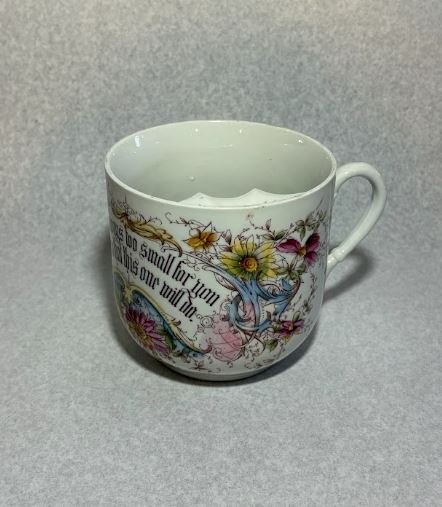
This comically oversized tea cup has an extra piece of porcelain across the lip of the bowl. This is a mustache cup, like the more reasonably sized one on display in Dalnavert’s kitchen. Mustaches were very fashionable in the late 19th century. A mustache cup was used to protect a man’s mustache from steam, as well as prevent his mustache wax from melting and dripping into his drink [6].
This mug has the inscription “The cup was always too small for you, I hope now that this one will do.” Think of this cup next time you see a world’s best dad mug.
5. Miser’s purse c. 1880-1900s. Beads, Fabric, Cotton. Country of Origin Unknown 978.6.11
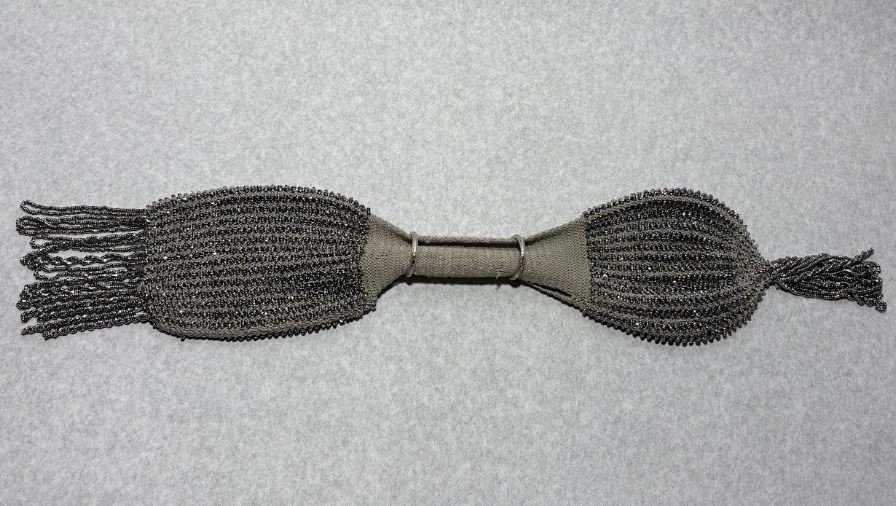
The word “miser” comes from the old French miserable, and meant “wretched” or “unhappy” in the 14th century. In the context of the miser’s purse, the word was used to describe someone who was penny-pinching, or a cheapskate [7].
A miser’s purse was used as a coin purse by both men and women. It was notoriously hard to get coins out of, giving the object its name. The square and rounded ends were designed so the user could easily differentiate which side their coins were on. The purse was held in the hand, similar to a modern-day clutch. It has a small slit in the middle where coins can be inserted. The two metal rings were pulled down toward either end of the purse to secure the coins and keep them from falling out. [8]
This particular purse was crocheted, with the addition of metal beads. [9] These purses could be bought, or were often handmade by women at home. Patterns for similar miser’s purses can be found in many knitting books of the time period. [10] Miser’s purses were popular into the 1920s. [11]
6. Candle holder c. 1880-1900s. Hoof and Bronze. Country of Origin Unknown 974.7.18
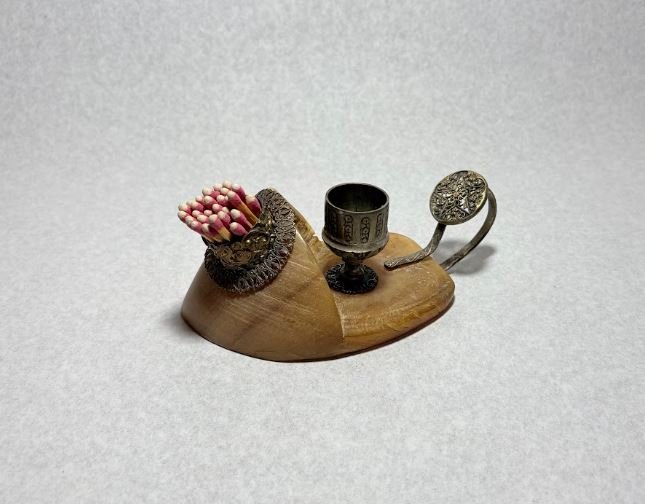
Sometimes, the story of an item gets lost to history, and it is our job as a museum to try to piece that history together. This candle holder has very little information attached to its record, but the materials it's made out of can tell us quite a bit. This candleholder is made from a domesticated animal hoof, as well as a bronze metal candlestick receptacle, handle, and match holder.
While we have no record of who made this item or why, some things can be learned from the object itself. Conservation biologist Bill Watkins answered some questions about what type of hoof this appears to be, and he determined it was most likely from a cow or ox.
The object is handmade, and has no maker's mark. The bottom of the hoof has marks from a rasp (like a nail file for animals with hooves), that suggests the animal this hoof belonged to was taken care of by people.
While there is not much more we can find out without the item’s provenance, it is interesting to wonder: who made this object? And for what reason?
7. Homeopathy kit c. 1870-1930. Leather Case, Glass Bottles with Cork, Various Remedies. Country of Origin Unknown 981.13.3
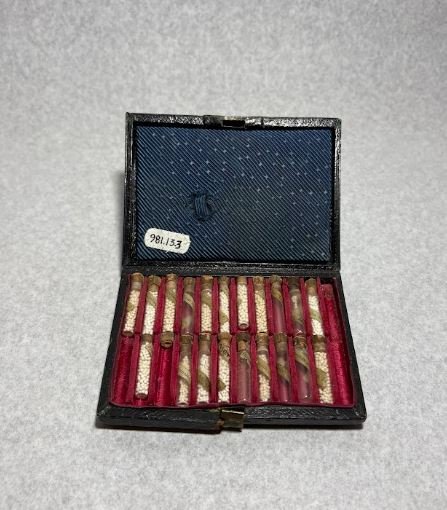
This pharmaceutical sample case was donated to the museum by the Manitoba Historical Society in 1981. It originally held 24 vials with various homeopathic remedies. Homeopathy is a form of alternative medicine that was created by Samuel Hahnemann, who lived from 1755 until 1843. [12]
The top lid of the case says Similia, Similibus, Curantur, which is Latin for “like cures like”, a tenant of homeopathy. Practitioners believe that an illness can be cured by giving a patient a remedy that would cause similar, less severe symptoms in a healthy patient.
Homeopathy hit its peak at a time when treatments like bloodletting, purgatives, and other extreme and ineffective procedures were practised by mainstream medical practitioners. By contrast, homeopathy (while still ineffective) [13] was non-invasive, and saw patients as whole people. [12]
Practitioners of homeopathy believe that medicinal ingredients need to be diluted, and given to patients in small doses. This practice is known as dynamization. These micro doses are diluted with different substances such as water, alcohol, or lactose. This is based on Hahnemann’s “centesimal scale”, which dilutes medicinal ingredients by a factor of one part per one hundred (1:100), or smaller. [14] While many of the same plant sources are used to create modern drugs today, because of this process of dilution, no traces of any medicinal substances remain in the finished homeopathic remedy.
Many of the labels in this case are aged or damaged, making them difficult to read. Left to right, here is what these labels say, and what the remedies inside were historically used for. These explanations come from A Dictionary of Practical Materia Medica by John Henry Clarke M.D., Volumes 1-3, published in 1900. [15]
Top Row:
“Coffea Cruda, 3.” A remedy derived from unroasted coffee beans. It was historically used to treat stroke, asthma, diarrhea, headache, sleeplessness, hysteria, labour pains, and sciatica, amongst others. [Volume 1, page 548]
“Cocculuus, 30.” Created from the seeds of the cocculus plant, this remedy was given to treat vertigo, seasickness, rheumatism, hernia, cerebro-spinal meningitis and menstrual headaches. [Volume 1, page 536]
“Ipecacuanha, 6.” Made from the root of the dried plant of the same name, it was used to treat mainly nausea, as well as anemia, colic, yellow-fever, whooping cough, an opium habit, and tetanus. [Volume 2, page 37]
“Hepar Sulp___ris Calcar., 6” According to Dr. Clarke, hepar is “an impure sulphide of calcium, prepared by burning in a crucible the white interior of oyster shells with pure flowers of sulphur”. It was used to aid in sickness of pregnancy (morning sickness), sore nipples, eczema, consumption, pneumonia, jaundice, herpes, sore throat, and syphilis. [Volume 1, page 886]
“Sulphur, 30.” Also called Brimstone. It was prepared by trituration, which is the process of grinding down one solid material with another to dilute it. As well as prepared by saturating the sulphur with alcohol. A microdose of the element was thought to treat cataracts, derangement of the liver, freckles, diabetes, affections of the ear, epilepsy, yawning, tonsillitis, and worms. [Volume 3, page 1299]
“Graphites, 30” Graphite, which was “prepared black lead from [the] finest english drawing pencils” was thought to treat amenorrhea (missing menstrual periods), dropsy, cancer, catarrh (build up of phlegm), gleet, noises in the head, cracked lips, something just called “grave!”, stomach cramps, ulcers, and tumors. [Volume 1, page 827]
“Sepiae Succus, 30.” Sepia, most familiar to a modern reader as the red-brown tone of old photographs, is an ink derived from cuttlefish. The ink was dried, powdered and distilled, then used by homeopaths to aid with baldness, dandruff, liver spots, inflamed or swollen nose, ringworm, spermatorrhea (excessive and involuntary seminal discharge), varicose veins, and warts. [Volume 3, page 1158]
“Cina, 30.” Collected and distilled from the seeds of flower-heads from the wormseed plant. Cina was given to patients by homeopaths to help with dentition (teething), colic, bronchitis, neuralgia (nerve pain), affections of the eyes and sight, as well as worms - hence the alternate name, wormseed. [Volume 1, page 510]
“Nux Vomica____” A muscle stimulant derived from the seeds of the strychnine tree, the remedy was used to treat digestion issues such as gastrodynia, biliousness (nausea and vomiting), masturbation, impotence, erotomania (excessive sexual desire), sour breath, waterbrash (acid reflux), sexual perversion, and nightmares. [Volume 2, page 613]
“Acomitum Napellus, 24.” A remedy made from the aconitum flower, also known as wolfsbane or monkshood. It was given to treat anger, sudden blindness, dropsy, mumps, pneumonia, labour pains, hemorrhage, gonorrhea, sleeplessness and effects of fear. [Volume 1, page 31]
“Calcarea Carbonica, 30.” An impure form of calcium carbonate, that was historically collected from different sources such as the “middle layer of oyster shells”, as well as “a trituration of carbonate of lime, precipitated from a mixture of chalk in hydrochloric acid”. It was thought to treat “depraved appetite”, “affects of alcohol”, sycosis of the beard (inflamed hair follicles), lupus, hysteria, delirium, paralysis, night terrors, spinal affections, disorders of smell, late walking, and typhoid. [Volume 1, page 329]
Bottom Row:
“Spongia, 30.” Made from roasting a “common sponge” and creating a tincture from “20 grains in 400 drops of alcohol”, which is a 1:20 dilution. Spongia was given by homeopaths to help treat cough, angina, clumsiness, constipation, myopia (nearsightedness), and affiliations of the testicles in patients. Dr. Clarke states that it is “best suited to blue-eyed, fair-haired patients” and not for brunettes. [Volume 3, page 1236]
“China Officinalis, 12.” A tincture of dried bark. It was used to treat coma, delirium, “affects of mercury” (poisoning), sleep disorders, facial neuralgia (nerve pain), tinnitus, tobacco habit, affections of the spleen, and self-abuse. [Volume 1, page 466]
“Rhus Toxicodendron, __” Poison Oak. Used for a variety of purposes including treating Beriberi (thiamine deficiency), acne, weak sight, inflammation of the glands, abortion, gout, measles, “feeble circulation”, small pox, sprains, and tumours of the ovary. [Volume 2, page 990]
“Vera_____” The second half of this word is unintelligible. There are 4 remedies in A Dictionary of Practical Materia Medica that start with “vera”, they are Veratrinum, Veratrum Album, Veratrum Nigrum, and Veratrum Veride. These remedies were derived from different varieties of the veratrum genus of flower plant, and often prescribed for issues related to menstruation. [Volume 3, pages 1505-1520]
“Opium, 3.” A highly addictive narcotic that was very common in the Victorian Era, opium is derived from poppies. Latex is excreted from the seed capsules of the plant, which is then collected, dried, and purified. Dr. Clarke writes it is “one of the most complicated substances in the materia medica” and recommends it for affections of the brain, constipation, dream, affections of the bladder, excessive movements of the fetus, effects of fear, chilblains, epilepsy, sunstroke, abnormal sleep, melancholia, and inertia of the uterus.
Because of the homeopathic practise of dilution (dynamization), there were most likely only trace elements of opium in this vial originally. [Volume 2, page 664]
“Belladonna, 30” Deadly Nightshade, today it is most well known as a deadly poison. This homeopathic tincture was made from the whole plant, just as it began to bloom. It was given to patients to help treat gout, excitement, abscess, carbuncles, convulsions, influenza, afflictions of pregnancy, nymphomania, sensitiveness, disordered smell, sore tongue, and vaccinia (similar to smallpox). [Volume 1, page 254]
“Nux Vomica, 30.” Another vial of Nux Vomica, possibly a different dosage/dilution. It was used to treat the same afflictions as the vial in the top row. [Volume 2, page 613]
“Bryonia Alba, 30. ” Derived from the white bryony plant, its fruit is highly poisonous. This remedy was thought to treat cancer, constipation, “affects of anger”, alcoholism, eczema, headache, cough and hiccough, sickness of pregnancy, thirst, coated tongue, suppressed eruptions, and “starts and screams when waking”. [Volume 1, page 302]
“Dulcamara, 24.” Woody Nightshade, often confused with Belladonna. Made from the stems and leaves of the plant just before it flowered, this remedy was given by homeopaths to treat warts, cholera, nettle-rash, herpes, myelitis (inflammation of the spinal cord), emaciation, stammering, stiff neck, incontinence and tonsillitis. [Volume 1, page 378]
8. Lorgnette c. late 1800s. Glass and Articulated Metal. Hamburg, Germany 982.5.1
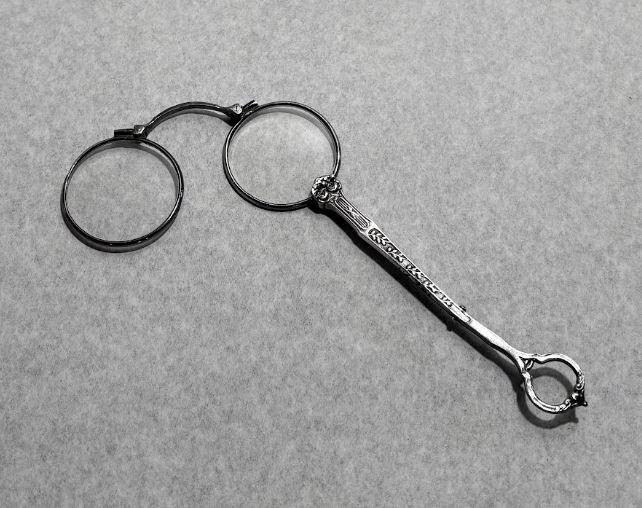
A lorgnette (pronounced lorn-yet) was a predecessor to opera glasses, and used in much the same way. This particular pair folds at the nose bridge, into a shape like a magnifying glass. This allows for a more intense magnification, and easy storage. There is a small button on the handle that releases the lenses back into the “glasses” position. The artifact has a small ring at the base of the handle, so it could be easily clipped to a chatelaine.
The word lorgnette comes from the french word “lorgner”, which means “to ogle”. [16] These accessories were popular in the 18th century with both men and women, and were used mainly for public performances like operas, ballets and plays. Lorgnettes were somewhat controversial, as those who used them were often perceived as nosy or paranoid. Into the 19th century, these items were seen as more practical and less impolite, and became an everyday accessory that helped those with vision issues, similar to how reading glasses are used today. [17]
9. Roller Skate Perfume Bottle c. 1885. Glass and Brass. New York, United States 975.13.1
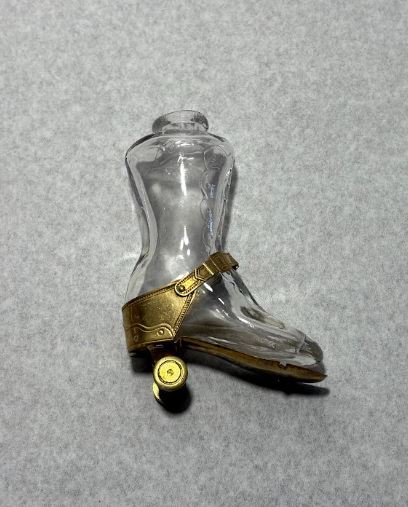
This perfume bottle was created by Daniel R. Bradley & Son in NYC, patented July 28 1885. Originally, the bottle had another pair of brass wheels at the front of the skate, as well as a cork stopper and paper label. Called the Roller Skate Bouquet, this bottle is made from blown, pressed glass, and features subtle laces on the front of the skate. It is quite rare, and prized among collectors. It is a favourite of the International Perfume Bottle Association, who helped us here at Dalnavert Museum identify this eccentric and quirky artifact.
References
[1] Museum, Victoria and Albert. “Teddy Bear: V&A Explore the Collections.” Victoria and Albert Museum: Teddy Bear, January 7, 2010. https://collections.vam.ac.uk/item/O1152697/teddy-bear-schuco/.
[2] Roller Skates, March 25, 2025. https://www.museumofplay.org/toys/roller-skates/.
[3] Love, Myron. “Manitoba History: The Winnipeg Roller Rink.” Manitoba history: The Winnipeg Roller Rink, Spring 1985. https://www.mhs.mb.ca/docs/mb_history/09/winnipegrollerrink.shtml.
[4] “The Winnipeg Roller Rink: Let the Good Times Roll!” Heritage Winnipeg, June 13, 2023. https://heritagewinnipeg.com/blogs/the-winnipeg-roller-rink-let-the-good-times-roll/.
[5] Padilla, Michelle. “When the Glass Workers Marched on Parade.” Corning Museum of Glass BLOG, September 25, 2018. https://blog.cmog.org/2018/when-glass-workers-marched-parade.
[6] “Nineteenth Century Mustache Cups.” Rosenberg Library Museum Treasures, 2025. https://www.rosenberg-library-museum.org/treasures/nineteenth-century-mustache-cups.
[7] “Miser - Etymology, Origin & Meaning.” n.d. Online Etymology Dictionary. Accessed January 30, 2026. https://www.etymonline.com/word/miser.
[8] The Miser's Purse: Demo by Laura Camerlengo. 2013. Featuring Laura Camerlengo. Copper Hewitt, 2013. https://www.youtube.com/watch?v=IlLv-RmSnnI.
[9] Smithsonian Institution. n.d. “Miser's Purse.” National Museum of American History, Behring Center. https://americanhistory.si.edu/collections/object/nmah_881409.
[10] Vogelsang, Gillian. n.d. “You Cannot Go Outdoors Without a Miser's Purse.” Textile Research Centre. https://www.trc-leiden.nl/trc/index.php/en/blog/1273-no-lady-went-outdoors-without-a-miser-s-purse.
[11] Camerlengo, Laura L. Thesis. Ubiquitous Miser’s Purse, 2010. https://repository.si.edu/server/api/core/bitstreams/b9b9a538-4b32-4a59-a38c-f70c1a589703/content.
[12] Loudon, Irvine. “A Brief History of Homeopathy.” Journal of the Royal Society of Medicine, December 2006. https://pmc.ncbi.nlm.nih.gov/articles/PMC1676328/.
[13] Canada, Health. “Evidence for Homeopathic Medicines.” Canada.ca, September 19, 2025. https://www.canada.ca/en/health-canada/services/drugs-health-products/natural-non-prescription/legislation-guidelines/guidance-documents/evidence-homeopathic-medicines.html#a1.
[14] “Homeopathic Medicine Potency or Dilution.” Homeopathic Potency and Dilution, December 29, 2003. https://web.archive.org/web/20150821064849/http://www.ritecare.com/homeopathic/guide_potency.asp.
[15] Clarke, John Henry. A Dictionary of Practical Materia Medica. Internet Archive. Vol. 1–3. 3 vols. London, England: The Homeopathic Publishing Company, 1900. https://www.gemasi.ong.br/old/pdf/livros-publicacoes/diversos/materia-medica-by-john-henry-clarke-volume-1/materia-medica-by-john-henry-clarke-volume-1.pdf, https://archive.org/details/b29808108_0002/page/36/mode/2up, https://archive.org/details/b29808108_0002/page/n7/mode/2up.
[16] “Lorgnette.” London Museum. Accessed February 11, 2026. https://www.londonmuseum.org.uk/collections/v/object-64524/lorgnette/.
[17] “The History of the Lorgnette.” Mimi Matthews, July 14, 2021. https://www.mimimatthews.com/2015/09/20/the-history-of-the-lorgnette/.