Dalnavert, in Blue

Dr. Kyle McPhail, Intern Curator

The colour blue has a very complex history with origins in Afghanistan, journeying down the Silk Road to Renaissance Venice and eventually ending up being manufactured in the laboratories of Germany. In the classical period, for the Romans the colour was a symbol of misfortune, mostly due to Celtic soldiers wearing blue body paint. Later to people in the Middle Ages, it was considered divine and associated with the Virgin Mary, with most images of Mary depicting her wearing blue robes. In the 12th century blue was embraced by royalty and became the royal colours of France. This association with royalty, and the Virgin Mary, made the colour blue’s popularity increase over the centuries. During the Industrial Revolution it was a symbol of the improvements of pigment manufacturing. The discovery of synthetic blue pigments made it accessible and among the most popular colours used by artists. From religion, to royalty, to industry and then to art, let’s take a closer look at blue.  

Lapis lazuli and ultramarine blue

The key to most blue pigments is lapis lazuli. This semi-precious and complex rock was mined in parts of Afghanistan as early as the 7th century BCE. For most of the colour blue’s history, this was the only place people mined for lapis lazuli. It was very expensive; in fact, it was similar in price to gold. Additionally, there is evidence and artworks from Ancient Mesopotamia and Ancient Egypt that show the use of lapis lazuli, however they did not grind it to make a pigment. Due to its composition, when they would attempt to grind it, the colour would end up being grey rather than a brilliant blue.

In the 6th century CE people figured out how to properly utilise the pigment by mixing it with several materials to form a paste and then heating it. It was then used to create a colour known as ultramarine blue. It did not make it to Europe until the Middle Ages; however, for centuries it had been traded along the Silk Road, an ancient trading route that linked East Asia and Southeast Asia with South Asia, Persia, the Arabian Peninsula, East Africa and Southern Europe. Eventually it made its way from Afghanistan to the Mediterranean via the Silk Road. An example of a Middle Ages artwork featuring lapis lazuli is the illuminated manuscript The Book of Kells, from the late 8th early 9th century. The presence of the pigment means that the lapis lazuli went all the way from Afghanistan to Scotland, where the book was made. This shows that a great deal of money was paid to create the illuminated manuscript, but also how precious and important the colour was to those creating the artwork. Blue, or specifically ultramarine blue, was often used in images of the Virgin Mary. Her robes would be painted blue, this was meant to represent wisdom and humanity. Due to the expensive price of the pigment, this was an extra honour to Mary in religious paintings.


Venice was an important city for art during the Renaissance in the 15th and 16th centuries. As Venice would be the first city to receive many of the shipments from the east, the artists of Venice were the first to use pigments like ultramarine blue. There are many examples from the late 15th and 16th centuries of Renaissance artists using ultramarine blue, for example artists like Michelangelo, Titian and Raphael used the pigment. Early in the Renaissance, Titian used ultramarine in many of his paintings, including Bacchus and Ariadne (1520–23). A century later, Baroque artist Johannes Vermeer’s most well-known painting, Girl with the Pearl Earring (c. 1665) notably features ultramarine blue in the turban of the young woman at the centre of the painting. Another Baroque artist Artemisia Gentileschi was known for her rich colour use, also included ultramarine in her dramatic artworks.

The use of ultramarine blue faded with the Industrial Revolution and the invention of cheaper and more accessible synthetic colours. In fact, the first modern synthetic pigment was a shade of blue. Eventually, in the 19th century a synthetic ultramarine was invented.


Prussian Blue

Prussian blue is considered the first modern synthetic pigment. This dark blue is an iron pigment and was first introduced in the early 1700s, and ever since it has been widely used in art and design. It was accidentally discovered by Johann Diesbach, who was attempting to make red but didn’t have the proper ingredients. Diesbach then was adamant in trying to figure out exactly how the chemicals he mixed created such a wonderful colour. As it turns out, the potash (used in many pigments) had animal blood in it, which contains iron. The iron created a chemical reaction that resulted in blue. 

            Prussian blue is a very recognisable colour in paintings and has been frequently used since its invention. The earliest known usage of Prussian blue was in Jean-Antoine Watteau’s Pilgrimage to Cythera (1717).


Pilgrimage to Cythera (1717) Jean-Antoine Watteau  Source: https://smarthistory.org/antoine-watteau-pilgrimage-to-cythera/.

Pilgrimage to Cythera (1717) Jean-Antoine Watteau
Source: https://smarthistory.org/antoine-watteau-pilgrimage-to-cythera/.

Apart from being the first known artist to have used Prussian blue, Watteau is considered to be the originator of French Rococo style painting. In 1723 it was used in America as an interior wall pigment, showing that the popularity of the pigment reached beyond Europe.

After its invention Prussian blue quickly became a favourite pigment of artists and was used heavily on many palettes. It was non-toxic and affordable. It did have a tendency to fade, as noted in paintings by Thomas Gainsborough who was a fan of using Prussian blue, notably The Blue Boy (c.1770). During the Victorian era, Prussian blue was popular and fashionable in decorative design. It is a very versatile pigment, being used to mix with other pigments to create a range of colours but also on its own being very vibrant.  Some well-known artists favoured it, including Vincent van Gogh. Perhaps the most striking example of van Gogh’s use of Prussian blue is Starry Night (1889). Also, due to trading with the Netherlands, the pigment was also available in Japan, and was extensively used in the 19th century.  One of the most recognisable artworks to utilise Prussian blue is The Great Wave off Kanagawa (c.1829-33) by Katsushika Hokusai.

Worldwide, Prussian blue has been not only used on an artist’s palette, but to colour linoleum, cosmetics, automotive painting and was the original colour of blueprints.

The Great Wave off Kanagawa (c.1829-33) Katsushika Hokusai. Source: https://www.metmuseum.org/art/collection/search/45434.

The Great Wave off Kanagawa (c.1829-33) Katsushika Hokusai. Source: https://www.metmuseum.org/art/collection/search/45434.

Cobalt Blue

Another important blue of the 19th century was cobalt blue. Although it had been around for centuries and used in China, Louis-Jaques Thénard’s 1802 synthetic version of cobalt blue improved on the original recipe. It was this new synthetic version that took off in the Victorian era, and was used by many artists like blue enthusiast Vincent van Gogh, Pierre-Auguste Renoir and Mary Cassatt, for example in the painting Little Girl in a Blue Armchair (1878).  

Blue is very representative of the Victorian era in that blue was one of the first synthetic pigments. The Victorians had a fascination with new inventions and wanted to implement them and/or display them in their home. Additionally, there are many blue decorative objects in Dalnavert, most of which are cobalt blue. Blue has played a significant role in the histories of art and remains one of the most popular colours.

 This is part of a series of blog posts related to our Dalnavert, in Colour exhibit. Look out for posts on more colours!


Bibliography


Cascone, Sarah. ‘In Pre-Industrial Europe, Blue Pigments Were Exceedingly Rare. But an Ocean Away, the Maya Had Their Own, Widely Available Blue.’ Artnet. 07/08/2020 [retrieved 18/02/2021]. https://news.artnet.com/art-world/maya-blue-ancient-superblue-chichen-itza-1899627.


Feller, Robert L. Artists’ Pigments: A Handbook of Their History and Characteristics, Vol.I. Washington: National Gallery of Art, 1986.


Fitzhugh, Elizabeth West (ed.). Artists’ Pigments: A Handbook of Their History and Characteristics, Vol. III. Washington: National Gallery of Art, 1997.


Gottesman, Sarah. ‘The 6,000-Year History of Blue Pigments in Art.’ Artsy. 29/11/2016 [retrieved 18/02/2021]. https://www.artsy.net/article/artsy-editorial-a-brief-history-of-blue.


Hulsey, John and Ann Trusty. ‘The Color That Changed the World.’ Artists Network. N/D [retrieved 18/02/2021]. https://www.artistsnetwork.com/art-techniques/color-mixing/world-changing-color-prussian-blue/.


Roy, Ashok. Artists’ Pigments: A Handbook of Their History and Characteristics, Vol. II. Washington: National Gallery of Art, 1993.


St Clair, Kassia. The Secret Lives of Colour. London: John Murray, 2016.
Date Like a Victorian: Courtship and Romance in the Victorian Era

Ayda Loewen-Clarke, Creative Programming and Digital Media Intern

Many modern ideals surrounding love and marriage today have their roots in the Victorian era. By the beginning of the 19th century, marriages for economic and social purposes were falling out of popularity. Instead, the evolution of the family unit led to a heightened societal value for marriages based on mutual affection, emotional satisfaction, and love.[i] Called the “companionate marriage”, this ideal shaped the way that people met and courted in the 19th century. The ideal of marriages based on love gave young people, especially women, a new level of agency in their choice of partners.

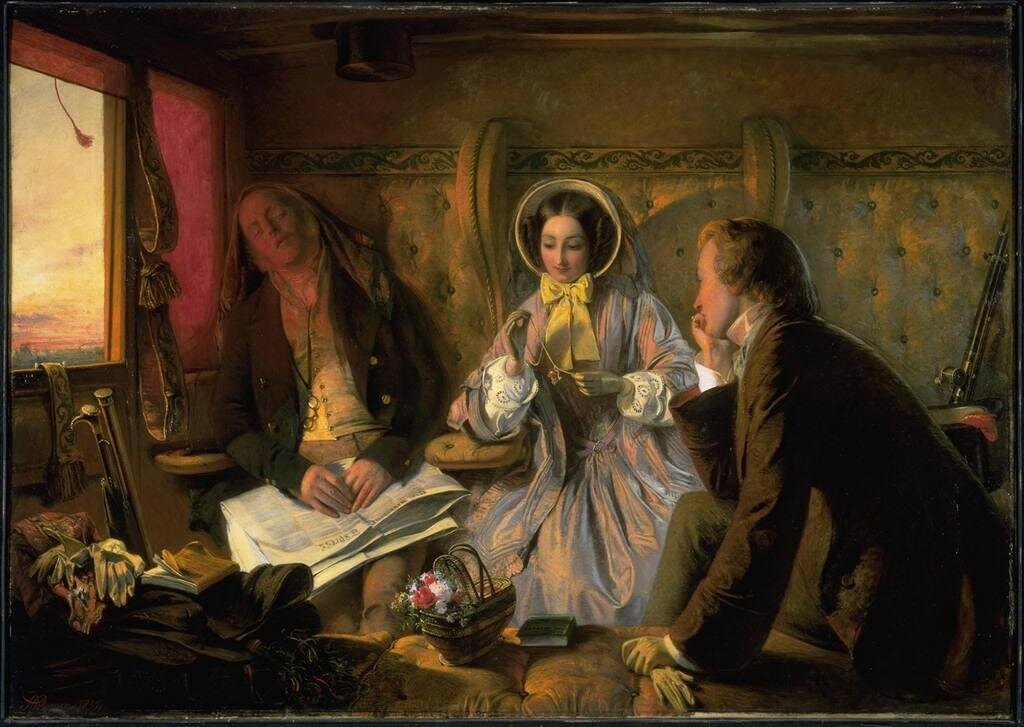
The concept of ‘love at first sight’ originated in the Victorian era, along with the ideal of the companionate marriage. Painting by Abraham Solomon, “First Class: The Meeting… and at First Meeting Loved,” oil on canvas, 1854. Part of the collection…

The concept of ‘love at first sight’ originated in the Victorian era, along with the ideal of the companionate marriage. Painting by Abraham Solomon, “First Class: The Meeting… and at First Meeting Loved,” oil on canvas, 1854. Part of the collection of the National Gallery of Canada: https://www.gallery.ca/collection/artwork/first-class-the-meeting-and-at-first-meeting-loved

The widespread ideal of the companionate marriage had consequences beyond heterosexual marriages, as well. Sharon Marcus asserts that the newly held belief that it was better to not marry at all than to marry without love made space for people to choose to remain unwed. Further, the evolution of marriage laws allowed a certain amount of flexibility that allowed female couples living together to use the language of marriage to describe their relationships as well.[ii]

Because of the rise in popularity of the companionate marriage, young people had more independence in their choice of partners than previous generations. However, with the parents no longer being the primary facilitators of romantic relationships, the ways that couples found each other also changed. While some couples still met through their parents or other family members, people also met through mutual friends or because they were neighbours. In addition, many people met through work or social events like picnics and church-related activities.[iii]

Another (less common) way of finding a partner was through matrimonial advertisements. Published in periodicals, matrimonial advertising began mostly in working-class communities, but spread to the upper classes by the 1870s. In the article “Victorian Girls Gone Wild: Matrimonial Advertising and the Transformation of Courtship in the Popular Press,” Jennifer Phegley argues that matrimonial advertisements provided new opportunities for lonely singles to find each other and increased women’s agency in courtship. While these advertisements could provide people with a way to find a compatible partner without relying on making connections through their existing social circles, they came with a certain amount of social stigma. These ads challenged traditional gender roles of masculinity and femininity, as women were upfront about their wants and needs in their searches for husbands. Women who posted advertisements were often considered immodest.[iv] However, these “immodest” practices were ultimately a precursor to women’s positions as more equal partners in courtship by the beginning of the 20th century.

It could be said that matrimonial advertisements were the dating apps of the Victorian era.

It could be said that matrimonial advertisements were the dating apps of the Victorian era.

            No matter how they initially met, courtships were usually short, and couples were often engaged within nine months, oftentimes less.[v] During the time of courtship, couples found several ways to spend time together and grow their ties to each other. In the public sphere, they would go on long walks and attend community social events together. Most courtship happened in the private realm, however, as men would call on women at home and have tea or supper with her and her family. Despite this, parents often allowed couples a certain amount of privacy together in the home after these meals. At times, this led to “complications”, but the practice was nonetheless fairly universal.[vi]

Though courtships were short, engagements were commonly much longer, and usually lasted several years. This was especially the case for working-class couples, as they had to work to save money for the marriage. During the engagement, couples exchanged gifts. Though the gifts varied widely depending on class and status, three types gifts were fairly universal. People commonly exchanged engagement rings. They also often traded pictures of each other or had their photograph taken together. Lastly, couples often exchanged locks of hair. This was a gift that “involved no expense and was a sure sign of intimacy.”[vii] More often than gifts, however, couples wrote each other letters. As they were sometimes separated for long periods of time during their engagements because of work and familial obligations, letters were the main source of communication. Many relationships developed in a large part through the written word.

These items from the Dalnavert Museum collection represent some common gifts that lovers would exchange. Locks of hair could be kept in jewellery like this brooch.

These items from the Dalnavert Museum collection represent some common gifts that lovers would exchange. Locks of hair could be kept in jewellery like this brooch.

Though many things have changed and evolved since then, the Victorians’ value for love-based marriages shaped our own cultural understanding and experiences of romantic relationships today. So, if you’re stuck on what to do this Valentine’s Day, take a page out of the Victorian’s books – go for a long walk, send a letter or cute picture, give your lover a lock of your hair, or take out an ad in the local newspaper describing your ideal partner.

Happy Valentine’s Day!

[i] Jennifer Phegley, Courtship and Marriage in Victorian England, Santa Barbara, California: Praeger, 2012.

[ii] Sharon Marcus, Between Women: Friendship, Desire, and Marriage in Victorian England, Princeton: Princeton University Press, 2007, 211-212.

[iii] Ginger S. Frost, Promises Broken: Courtship, Class, and Gender in Victorian England, Charlottesville And London: The University Press of Virginia, 1995, 58.

[iv] Jennifer Phegley, "Victorian Girls Gone Wild: Matrimonial Advertising and the Transformation of the Popular Press," Victorian Review 39, no. 2 (2013): 132.

[v] Frost, Promises Broken, 61.

[vi] Frost, Promises Broken, 63.

[vii] Frost, Promises Broken, 64.


Bibliography

Frost, Ginger S. Promises Broken: Courtship, Class, and Gender in Victorian England. Charlottesville And London: The University Press of Virginia, 1995.

Marcus, Sharon. Between Women: Friendship, Desire, and Marriage in Victorian England. Princeton: Princeton University Press, 2007.

Matthews, Christopher. "Love at First Site: The Velocity of Victorian Heterosexuality." Victorian Studies 46, no. 3 (2004): 425-54. https://doi.org/muse.jhu.edu/article/173476.

Phegley, Jennifer. Courtship and Marriage in Victorian England. Santa Barbara, California: Praeger, 2012.

Phegley, Jennifer. "Victorian Girls Gone Wild: Matrimonial Advertising and the Transformation of the Popular Press." Victorian Review 39, no. 2 (2013): 129-146. https://doi.org/10.1353/vcr.2013.0060.

Dalnavert Staff Lockdown List PART II

How has the Dalnavert staff been passing time in lockdown? Below you’ll find MORE of the music, podcasts, books, TV shows, and video games that are keeping us entertained this month.

PODCASTS

Historical Friction: Hosted by Alice Procter, Historical Friction is a podcast about storytelling, pop culture, the past, and why we reenact it.

Storytelling / Story-listening: Hosted by Jessica Hum, this podcast explores multiple Indigenous and cultural epistemologies, documenting oral stories and teachings as a method of preparation for climate change.

Ologies: Science correspondent Alie Ward interviews professional “-ologists” who specialize in topics including astrobiology (space biology), scorpiology (scorpions), ludology (games), and everything in between. Start with the episode on museums (museology) here.

Brainwashed: This CBC podcast explores the Canadian links to the CIA's covert experiments in mind control in the 1960s via the MKULTRA program. The Allan Memorial Institute in Montreal serves as the backdrop of this frightening tale of psychiatry gone wrong. Whilst detailing the terrible toll these experiments had on patients and their families, the narrative also explores the ethical shortcomings of intelligence agencies and governments since WWII, spanning the Cold War to the War on Terror, in the baffling race to control minds.

TV shows (for kids) 

Clifford The Big Red Dog (from 2001): Clifford is a great show to watch if you have small children at home, and you’ll appreciate the great voice acting and fun that is this show from 20 years ago. John Ritter, Cree Summer, Kel Mitchell are super fun to listen to.

Kiri and Lou (CBC Gem): This cute and short show from New Zealand is soft on the eyes (muted colours and claymation) so it is perfect for littles. There is always a very fun song in each episode and the comedy is fun to enjoy for adults and kids. Plus for those who loved New Zealand’s Flight of The Conchords, the character Lou is voiced by Jemaine Clement.

TV Shows (for grown-ups)

Bridgerton (Netflix): Bridgerton is a classic bodice-ripper romance made for modern audiences (think Jane Austen meets Gossip Girl). The lavish, bright Regency-era set and costumes alone make this series worth the watch. Honourable mention also goes to the soundtrack of pop songs performed by a string quartet.

Burden of Truth (CBC Gem): a suspenseful legal drama series that is not only filmed in Manitoba, but set here too!

MUSIC

Medieval Bardcore: the musical genre sweeping the internet. Bardcore, also known as ‘Tavernwave’, is like if you took your favourite 21st century pop hit  and threw in a harpsichord and your grandma’s church choir. Stream-eth renowned bardcore composer ‘Hildegard von Blingin’ on ye olde tube of you here.

Sea Shanties: Historically, sea shanties were labour songs, sung by working men on ships in the 19th century. The genre is currently going through a cultural resurgence, and it's no wonder. Themes of hardship, isolation, and longing, combined with generally upbeat melodies, make these classic songs the perfect soundtrack to an extended lockdown. We recommend starting with Great Big Sea, The Pirates Charles, and The Dreadnaughts.

Ys - Joanna Newson: Want to feel like a peasant frolicking gayly in a field of flowers in the 1500’s? Classical harpist, singer, and married to Andy Samberg, Joanna Newsom is the musical genius you’ve never heard of <3

Merry Christmas Lil' Mama: This is the 2020 version of a Christmas mixtape first released by Chance the Rapper and Jeremih in 2016 via Soundcloud. It's an inventive, joyful collection of songs that celebrates family, friendship and Christmas. It's also a mix bag of styles (from gospel to trap) which doesn't always work but never loses its spirit of fun.

Fantasy Baseball at the End of the World - John K. Sampson: Local musician Sampson (headman of The Weakerthans) released this single back in July, but its sentiment still rings true. It is a highly relatable ballad about the emotional rollercoaster that is living through a simultaneous public health crisis and political upheaval. It ends with some optimistic advice we can all take these days - I’m going outside / and gonna help organize / something better, something beautiful.

Video Games

A Short Hike (Nintendo Switch): Created by the Canadian developer Adam Robinson-Yu, this peaceful little game centres around a young bird called Claire who explores Hawk Peak Provincial Park. As you hike, swim and fly across the beautiful terrains you encounter other small animals enjoying their lives. There are enough puzzles and games to keep it interesting, but the real joy is in taking your time to ramble and explore. This is about as anxiety free as a game can get.

Books 

The Picture of Dorian Gray by Oscar Wilde: A Victorian classic that proves that the ultimate dedication to youthfulness isn’t plastic surgery or an expensive skincare routine, it’s selling your soul! Through the gothic novel, Wilde exposes society’s inherent obsession with youthfulness and beauty, and its willingness to overlook depravity for a pretty face.

Cold Comfort Farm by Stella Gibbons: Written in 1932 this is a parody of all your favourite romance / rural British life novels and it is hilarious! There is a movie from 1995, and it is no. 57 on The Guardian’s 100 best novels and is on top of many lists for comedy novels. Reading this after Wuthering Heights and it has lent much depth and context to the comedy.

Inward Journey: The Life of Lawren Harris by James King: This biography gives an incredibly detailed account of Lawren Harris’ life as a painter and prominent member of the Group of Seven. A must-read for any fan of Canadian art history!

Social Media Accounts 

@WpgDaylightTkr on Twitter: The Winnipeg Daylight Tracker provides updates on how much daylight we gain in Winnipeg each day - an optimistic reminder that spring is coming!

@blackcraftspeopleda on Instagram: The Black Craftspeople Digital Archive highlights the stories of Black craftspeople and the objects they created. Their Instagram page is a well-curated and informative snapshot of this archive.

@erenanaomi on TikTok: Elena Kanagy-Loux is a lace maker as well as a collections specialist at the Metropolitan Museum in New York. As you watch her make lace creations, she educates the audience on textile and fashion histories. It is both relaxing and fascinating watching her make lace, but also you learn something! 

Dalnavert Staff Lockdown List

How has the Dalnavert staff been passing time in lockdown? Below you’ll find the music, podcasts, books, and websites that are keeping us entertained. We hope you get some joy out of them as well!

Podcasts

Literature Out Loud: Listen to classic Victorian stories, accompanied by historical and cultural analysis by experts, with Dalnavert’s own Literature Out Loud podcast. Adults should check out the episodes on H.G. Wells’s The Time Machine, while kids can enjoy Alice’s Adventures in Wonderland by Lewis Carroll 

Museopunks: Suse Anderson interviews museum professionals and academics about the potential for progressive museum spaces.

ArtCurious: Hosted by Jennifer Dasal; fun introduction into art history.

Overdue: “Podcast about the books you’ve been meaning to read”.

Revisionist History: Hosted by Malcolm Gladwell; re-examining history.

Stuff You Missed in History Class: We recommend the old episodes, particularly the ones on The Bloody Benders or H.H. Holmes if you’re into old-timey true crime.

Books (Fiction)

The Law and the Lady by Wilkie Collins: Thought of as the “first full-length novel with a woman detective as its heroine,” The Law and the Lady follows Valeria Woodville as she tries to prove her husband’s innocence. Valeria’s “quest draws her into a maze of false clues and deceptive identities, in which the exploration of the tangled workings of the mind becomes linked to an investigation into the masquerades of femininity.”

People of the Book by Geraldine Brooks: “The story focuses on imagined events surrounding the protagonist and real historical past of the still extant Sarajevo Haggadah, one of the oldest surviving Jewish illuminated texts.”

Moon of the Crusted Snow by Waubgeshig Rice “A daring post-apocalyptic novel from a powerful rising literary voice. With winter looming, a small northern Anishinaabe community goes dark” (how topical).

Carson Crosses Canada by Linda Bailey and Kass Reich: This is a fun kids book in which Annie Magruder loads up her rattlebang car and sets off from her home in Tofino, BC with her dog Carson to visit her sister Elsie in Witless Bay, Newfoundland. Her journey across Canada is a nice introduction to the diverse geography and cultures of the country.

The Mercies by Kiran Millwood Hargrave: A historical fiction novel set in the 1600s on the tiny Arctic island of Vardø, in a fishing village where a storm has wiped away all the menfolk, leaving the women to rebuild their community. Their newfound strength is shaken, however, when the church’s suspicion of witchcraft begins to spread North. The stark seclusion of the setting, combined with the radical strength of the people who persevere despite this, offers a certain comfort as we head into our own cold months of isolation.

Coraline by Neil Gaiman: A darker look at an Alice’s Adventures in Wonderland type of story. For young adults, and young-at-heart adults.

Books (non-fiction)

Stolen City: Racial Capitalism and the Making of Winnipeg by Owen Toews: Stolen City offers an accessible but in-depth discussion of how settler colonialism and racial capitalism have shaped and reshaped the urban landscape of the City of Winnipeg over the past 150 years.

Prairie Fairies: A History of Queer Communities and People in Western Canada, 1930-1985 by Valerie J. Korinek: Focusing on several cities, including Winnipeg, Korinek examines the queer experience in rural and urban people in the prairies. Community, activism and the lived experience of queer people on the prairies challenges the normative perceptions of Winnipeg and prairie histories.

Black on Both Sides: A Racial History of Trans Identity by C. Riley Snorton: Focusing on the intersections of race and transness from the mid-19th century to present, Snorton outlines a thorough and often violent history of trans black people. As violence against black trans people continues and is sadly a near daily occurrence, Snorton’s book feels more important than ever.

The Whole Picture: The colonial story of the art in our museums & why we need to talk about it by Alice Procter: Known for her Uncomfortable Art Tours in London, Procter continues her quest to expose and acknowledge museum’s colonial histories. She encourages readers, and museum visitors, to question what is being told through museum collections, but also what is missing.

Rooster Town: The History of an Urban Métis Community, 1901–1961 by Adrian Werner, Evelyn J. Peters, and Matthew Stock: Rooster Town reconstructs the history of the Urban Métis settlement in Winnipeg, bringing light to the multiple instances of land dispossession that Métis faced during the evolution of the City of Winnipeg.

Songs and Ballads from Nova Scotia by Helen Creighton: Originally published in 1932, this is a collection of 150 folk songs from Nova Scotia which displays the rich heritage of the region, drawing as it does on Gaelic, English, German, Mi'kmaq, Acadian and African influences. The songs themselves are bawdy, bleak, funny and offensive. They include some unique versions of the Child ballads, and I enjoy it for the interpretations of Irish folk songs I grew up with. Having crossed an ocean and settled in the fisherman's cabins of Devil's Island, songs like The Cruel Mother become uncanny but no less enjoyable.

Websites

Dalnavert Museum Virtual Tour: Virtual Reality allows unprecedented access to our heritage house from the comfort of our visitors’ computers or mobile devices.

The Virtual Museum of Canada: Managed by the Canadian Museum of History, this website features digital exhibits from museums all over Canada. 

Window Swap: Stuck inside? Open a new window somewhere in the world - WindowSwap gives you the ability to look through others’ windows.

Send in the Clowns: A showcase of Canadian clowns (featuring one of Dalnavert’s own staff members!)

Social Media Accounts

@VictorianHumour on Twitter: jokes from 19th-c books and newspapers.

@BlackCountryMuseum on TikTok: an open-air museum in the English countryside that’s always on top of the trends.

@historycoolkids on Instagram: showcases archival photos, videos, and textual material, while giving well-researched and entertaining context in the captions.

Music

Deep Listening by Pauline Oliveros, Stewart Dempster and Panaiotis: The pandemic has resulted in me listening to fewer podcasts and more music. This album was recorded in 1988 in a cistern 14 feet underground in Washington where the acoustics are, well, cavernous and damp. It's a bit like listening to music from inside a whale. It's at times unsettling, but the experience encourages the listener to calibrate their ears and sharpen their attention. This might be my second wave soundtrack.

Stay safe and warm, Winnipeg!

Unwrapping the Mummy: Egyptomania During the Victorian Era

Drew Cruikshank, Intern

Egyptomania was a period of intense interest in ancient Egypt during the nineteenth century. This surge began in 1798 with the launch of Napoleon’s campaigns in Egypt and Syria, which aimed to increase trade, develop new alliances, and further scientific innovation (unfortunately, a fitting example of imperialism). It was on this expedition that they discovered the Rosetta Stone. Not long after, Europe began to see a proliferation of Egyptian aesthetics in its culture and design. The ‘exotic’ nature of Egypt consumed Western thought, revealing itself through literature, art, and culture. This included mummy unwrapping parties, stories such as Arthur Conan Doyle’s “Lot No. 249,” and in décor, including a few pieces that you can find at Dalnavert!

The Victorians let their intrigue cloud their judgement when it came to mummy unwrapping. A temporary form of entertainment for the Victorians was a complete desecration of Egypt, its people, and their ancestors. Anyone who could afford to travel to Egypt could afford to buy a mummy, although it took a trained individual to unwrap it. Thomas Pettigrew, who was a surgeon, antiquary, and author, was a well-known ‘unroller.’ Conflating science with spectacle, Pettigrew would host private parties where he would unwrap and perform autopsies on the mummies. The process was not very elaborate:

Following a lecture of Egyptian history and religion the lecturer and his assistants would gradually remove the textiles and other materials that encased the mummy. Fragments of the wrappings, pungent with resins and spices, were often passed around the audience along with the amulets and other artefacts encountered within them.[i]

These gatherings lasted for quite a while, thankfully dying out in the latter years of the century. While one can hope this is because the Victorians recognized their inhumanity, it is more likely, as Egyptologist John J. Johnston notes, to be a result of boredom.[ii] The process itself lacked lustre and many were disappointed when they discovered that the mummy was not going to suddenly come to life and walk around the room.

It was only in fiction that this fantasy of reanimation could be actualized. Several authors incorporated the motif of the mummy into their works, including Edgar Allan Poe in “Some Words with a Mummy (1845), Louisa May Alcott in “Lost in a Pyramid; or, The Mummy’s Curse” (1869), and, notably, Arthur Conan Doyle in “The Ring of Thoth (1890) and “Lot No. 249” (1892). In “Lot No. 249,” Abercrombie Smith learns that his neighbour, Edward Bellingham has been keeping an Egyptian mummy in his dormitory. After learning this, Smith makes several discoveries, suggesting that there is an evil within either the mummy or Bellingham. Being one of the first stories to surface which depicts the mummy as an actual threat, “Lot No. 249” calls imperialism into question and comments on the Victorians’ obsession with, and simultaneously their fear of, the foreign.

If you visit Dalnavert, you will notice that there are several pieces which share this Egyptian aesthetic. In the parlour, for example, there are two small fire screens, which prevented a lady from becoming flushed while sitting in front of the fire. These two screens display Egyptian iconography. As well, the Singer sewing machine’s upper black body, found in the sewing room, is decorated with Egyptian motifs.

Fire Screen with Egyptian Decoration

Fire Screen with Egyptian Decoration

Singer Sewing Machine with Egyptian Motifs (c. 1891)

Singer Sewing Machine with Egyptian Motifs (c. 1891)

The Europeans’ fascination with Egypt did make its way to North America around the same time; however, it was not nearly as immense. Aesthetics change and the Victorians’ enthusiasm did falter as time progressed. However, to this day, the spirit of ancient Egypt is still prevalent in the West. Opposed to the Victorians though, we try to celebrate ancient Egypt in a way that does not disrespect or appropriate its rich history and culture.

Bibliography

DHWTY. “Disrespect and Desecration at Victorian Mummy Unwrapping Parties.” Ancient Origins. 30 May 2018. https://www.ancient-origins.net/history-ancient-traditions/disrespect-desecration-victorian-mummy-unwrapping-0010129.

Moshenska, Gabriel. “Unrolling Egyptian mummies in nineteenth-century Britain.” BJHS 47, no. 3 (September 2014): 451-477. https://www-cambridge-org.uml.idm.oclc.org/core/services/aop-cambridge-core/content/view/56BF3B3408D2E13EB839FFD58CF738B4/S0007087413000423a.pdf/unrolling_egyptian_mummies_in_nineteenthcentury_britain.pdf

[i] Gabriel Moshenska, “Unrolling Egyptian mummies in nineteenth-century Britain,” BJHS 47, no. 3 (September 2014): 452. https://www-cambridge-org.uml.idm.oclc.org/core/services/aop-cambridge-core/content/view/56BF3B3408D2E13EB839FFD58CF738B4/S0007087413000423a.pdf/unrolling_egyptian_mummies_in_nineteenthcentury_britain.pdf

[ii] DHWTY, “Disrespect and Desecration at Victorian Mummy Unwrapping Parties,” Ancient Origins, 30 May 2018, https://www.ancient-origins.net/history-ancient-traditions/disrespect-desecration-victorian-mummy-unwrapping-0010129.

Authorship and Anonymity: Women Writers of the Nineteenth Century

By Drew Cruikshank, Intern

At the present time, most authors take immense pride in their work and have no issue with receiving credit for it. However, it was quite common for authors during the nineteenth century and prior to use pseudonyms. Authors would take on a nom de plume for a multitude of reasons, one of them being to avoid stigmatization from their society. Though, it was much easier for men to excel as authors for, as Charlotte Brontë wrote herself, authoresses were “liable to be looked on with prejudice.”[i] In spite of this bias, much of the nineteenth century’s most brilliant writing came from the pen of a woman. With this, we will be discussing seven leading authoresses of the nineteenth century who chose to remain anonymous, including Jane Austen, Amantine Lucille Aurore Dupin, the Brontë sisters, Mary Ann Evans, and Louisa May Alcott.


Jane Austen, or A Lady (1775-1817)

Portrait of Jane Austen by Cassandra Austen, c. 1810

Portrait of Jane Austen by Cassandra Austen, c. 1810

Regardless of whether you have actually read anything by Jane Austen, you have probably been assigned one of her novels at some point in your academic career and / or have seen one of the numerous adaptations that have been made. Austen is a household name, best known for novels like Pride and Prejudice and Sense and Sensibility. Despite being an esteemed author today, in her lifetime, Austen chose to remain anonymous, receiving a modest living from her novels. For her first published novel, Sense and Sensibility (1811), Austen decided to sign her work with ‘By a Lady.’ Unlike other writers of her time, she did not take on a male name. While she did not wish to reveal her own identity, she did want the general public to realize and understand that a woman, and more importantly a woman of high standing, was just as capable of writing a great novel than any man was. After the success of her first novel, Austen went on to publish Pride and Prejudice (1813), attributing it to ‘the author of Sense and Sensibility.’ She also published Mansfield Park (1814) and Emma (1815) anonymously. After she passed away in 1817, her brother published Northanger Abbey and Persuasion, revealing in the biographical note the truth about Austen’s identity.


Amantine Lucile Aurore Dupin, or George Sand (1804-1876)

Portrait of George Sand, 1864

Portrait of George Sand, 1864

Amantine Lucile Aurore Dupin was a French Romantic novelist—one of the best, surpassing her male counterparts. Finding married life too repressive, Dupin left her husband but soon realized that she would not be able to sustain herself on her measly monthly allowance and took to writing. After authoring a few collaborative novels, she wrote and then published Indiana (1832), which was the first novel she signed with the pseudonym George Sand. Unlike other authoresses, Dupin’s pseudonym quickly consumed her identity. For Dupin, her writing was an extension of herself, intended to raise women up from their “abject position.” In a letter to Frederic Girerd from 1837 she expands on this idea:

People think it very natural and pardonable to trifle with what is most sacred when dealing with women: women do not count in the social or moral order. I solemnly vow—and this is the first glimmer of courage and ambition in my life! —that I shall raise woman from her abject position, both through myself and my writing.[ii]

Taking her activism one step further, Dupin took to the streets, wearing menswear at a time when a woman wearing pants called for a hefty fine. In taking on a pseudonym and wearing whatever she pleased, Dupin actively subverted traditional gender roles.


Charlotte, Emily, and Anne Brontë, or Currer, Ellis, and Acton Bell (1816-1855; 1818-1848; 1820-1849)

Portrait of the Brontë Sisters (Anne; Emily; Charlotte) by Branwell Brontë, c. 1834

Portrait of the Brontë Sisters (Anne; Emily; Charlotte) by Branwell Brontë, c. 1834

Trying to succeed as an authoress during this time was incredibly difficult, since the expectation was that women would spend all of their time tending to their family. Further, the Brontës wished to delve into themes of class, sexuality, religion, and feminism in their novels—topics which the public considered taboo for women to write about. At times drawing from their own life experiences, Kristen Pond states that their novels focus on “the ways women’s lives do not fit within the strictures of the realist Bildungsroman plot.”[iii] After Charlotte had published her second novel, Shirley (1849), prominent critic George Henry Lewes (who would later form a relationship with Mary Ann Evans, better known as George Eliot) discovered that ‘Currer Bell’, the pseudonym that Charlotte had successfully been writing under for several years, was in fact Charlotte. Though, there has been discussion that Lewes’ did suspect that ‘Currer’ was in fact a woman, mentioning in his review that “the authoress is unquestionably setting forth her own experience.”[iv] Obviously disgruntled about Lewes’ discovery, Charlotte wrote in a letter to him in 1849 that she did not want the public to view her as a woman:

I wish all reviewers believed ‘Currer Bell’ to be a man; they would be more just to him. You will, I know, keep measuring me by some standard of what you deem becoming to my sex; where I am not what you consider graceful you will condemn me.[v]


Mary Ann Evans, or George Eliot (1819-1880)

Portrait of George Eliot by François D’Albert Durade, 1849

Portrait of George Eliot by François D’Albert Durade, 1849

Mary Ann Evans was one of the most dominant writers during the Victorian era, known widely for her novel Middlemarch (1871). Evans chose to write under a pseudonym because she wished to write more expansively, beyond just romances. Like other leading authoresses, she challenged the expectations that critics had for women’s writing. Eventually, though, the literary community accepted Evans as a writer, partially a result of her relationship with George Henry Lewes. While her relationship gave her more freedom to write as she pleased, she still felt criticism from those around her, specifically because Lewes was already a married man. Evans, like Dupin, was known by her pseudonym and chose to keep her alias.


Louisa May Alcott, or A. M. Barnard (1832-1888)

Portrait of Louisa May Alcott, 1870

Portrait of Louisa May Alcott, 1870

Louisa May Alcott was an American novelist, best known for her novel Little Women (1868-69). Prior to Little Women’s success, though, Alcott used several pseudonyms. As an up and coming writer, Alcott used the name Flora Fairfield, as she was not confident enough in her writing just yet to include her real name. Then, depending on what she wished to write about, Alcott would either use her real name or the pseudonym A.M. Barnard. She specifically used this pen name when she wrote thrillers—focusing on spies and revenge—like Behind a Mask, or, A Woman’s Power (1866) and The Abbot’s Ghost: A Christmas Story (1867). The name A.M. Barnard made it possible for Alcott to support herself financially and gave her the freedom to write without stigmatization. After publishing Little Women, Alcott tended to avoid discussing the novels she wrote under her pseudonym.

During the nineteenth century, authoresses would take on pseudonyms for several reasons; however, as we have seen with these seven women, more often than not it was because, as women, they were not regarded as ‘real’ writers by society’s standards. Nonetheless, they found power in anonymity and it is due to these women that we have some of the most well-known and praised classic books.

Bibliography

Gary, Franklin. “Charlotte Brontë and George Henry Lewes.” PMLA: Publications of the Modern Language Association of America 51, no. 2 (June 1, 1936): 518-542. https://www-jstor-org.uml.idm.oclc.org/stable/458068.

Pond K. (2019) Brontë, Charlotte. In: Scholl L. (eds) The Palgrave Encyclopedia of Victorian Women’s Writing. Palgrave Macmillan, Cham. https://doi-org.uml.idm.oclc.org/10.1007/978-3-030-02721-6_31-1.

Winegarten, Renee. The Double Life of George Sand, Woman and Writer: A Critical Biography. New York: Basic Books Inc., 1978.

[i] Pond K. (2019) Brontë, Charlotte. In: Scholl L. (eds) The Palgrave Encyclopedia of Victorian Women’s Writing. Palgrave Macmillan, Cham. https://doi-org.uml.idm.oclc.org/10.1007/978-3-030-02721-6_31-1, qtd. From Wuthering Heights, Norton Edition, p.4

[ii] Renee Winegarten, The Double Life of George Sand: woman and writer (New York: Basic Books Inc., 1978), 161.

[iii] Pond K. (2019) Brontë, Charlotte. In: Scholl L. (eds) The Palgrave Encyclopedia of Victorian Women's Writing. Palgrave Macmillan, Cham. https://doi-org.uml.idm.oclc.org/10.1007/978-3-030-02721-6_31-1

[iv] Franklin Gary, “Charlotte Brontë and George Henry Lewes,” PMLA 51, no. 2 (June 1, 1936): 527

[v] Ibid.

Remembering the Riel Resistance: Sir Hugh John Macdonald’s Colonial Involvement

The Red River Resistance was an initiative spearheaded by Louis Riel and the Red River Colony, most of the members being Métis. The Resistance disagreed with the Hudson’s Bay Company selling Rupert’s Land to the Canadian Government because it was not theirs (HBC’s) to sell. This blog post looks at Hugh John Macdonald’s involvement in both the Wolseley Expedition of 1870 and the North-West Rebellion of 1885, which set out to dominate the Métis and their Indigenous and European heritage.

Victorian Taxidermy and the Peculiar Life of Walter Potter

By Drew Cruikshank, Intern

One of the things that many people cannot wrap their heads around is the Victorians odd obsession with death and mourning—what made mummies, death photography, and our topic of today, taxidermy so fascinating. Well, first, we will need to understand how the Victorians viewed death. There was a definite shift in ideology from the Georgian era into the Victorian era. While rationalism marked the Georgian era, the Victorians’ views aligned more-so with the Romantics, who were intrigued by mysticism. Meaning that, although the Victorian era was a time of technological advancement and progress, culturally, the Victorians were prone to believe in the supernatural.

Taxidermy is the practice of preserving, sometimes stuffing, and mounting deceased animals. When a human family member passed away, they would receive quite an extensive mourning ceremony. When a family pet passed away, however, it was common to hire a taxidermist to preserve the animal, giving them a ‘second life.’ As Sarah Amato mentions in her chapter, “Dead Things: The Afterlives of Animals,” this “reflected the Victorian and Edwardian belief that animals should be useful to humans, even in death.”[1] Although the animal could no longer offer companionship, at least the family could use the taxidermized pet to swank-up their parlour. In an odd way, taxidermy was a tender attempt by the family to immortalize their pet.

For an example closer to home, quite literally, when Lady Macdonald’s pug passed away, she hired a taxidermist to have him stuffed. He then sat in a small wooden cage in the parlour until she sold him at an auction for 50 cents (so, if anyone has a dusty stuffed pug hidden away in their attic or basement, we are on the hunt for one).

Newspaper Clipping of Lady Macdonald's dog, "Dandy" c. 1940

While taxidermy was, on one hand, a way to memorialize, or immortalize, your beloved, deceased pets, the Victorians also viewed it as an artform. There were many amateur taxidermists (from the above newspaper clipping, Lady Macdonald’s pug clearly deserved someone with a little bit more expertise), but only a few were able to make a career out of it.

One of the few was Walter Potter. Born in 1835, Potter was an English taxidermist known for his anthropomorphic dioramas of animals mimicking real-life situations. Transfixed by Hermann Ploucquet’s tableaux, a German taxidermist with a similar style, after visiting the Great Exhibition of 1851, a young Potter began creating his own pieces.

Portrait of Walter Potter c. 1910. Image Source
t3.jpg

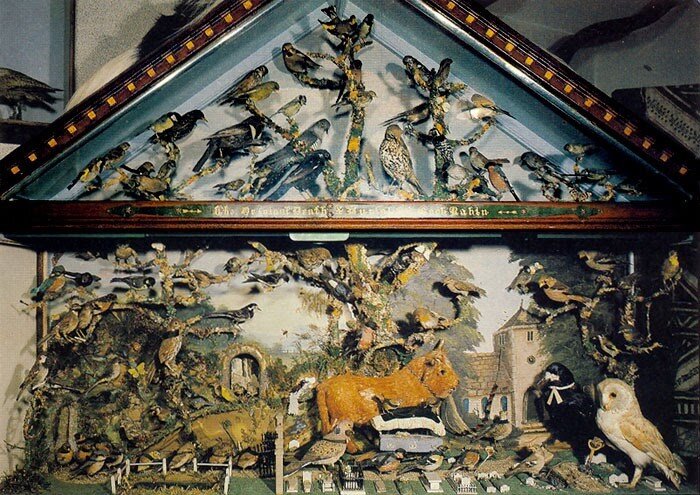
Potter accumulated quite the collection over his lifetime. One of his earlier pieces, which he started at the age of 19 and spent several years working on is “The Original Death & Burial of Cock Robin” (c. 1861). Inspired by the nursery rhyme “Who Killed Cock Robin,” this piece includes next to 98 specimens of British birds! In the same year, Potter opened his own museum to showcase his creations.

While Potter was clearly passionate, his taxidermy skills paled in comparison to say Ploucquet’s. However, where he lacked in precision, he made up for in his artistry, specifically in the minor details. One of his most famous pieces, which happens to be his last, is the “Kittens’ Wedding,” created in 1890.

t4.jpg
t5.jpg

This is one of my personal favourites – the whimsy of it all is truly engrossing. Your first reaction is probably either one of disgust or awe; however, you will be happy to know that Potter was not out murdering kittens for his pieces. On to the contrary, Potter only used previously deceased animals, which he received from a local farm.[2]

By the time Potter had died in 1914, his museum was coming to a stand-still. By the beginning of the twentieth century, people were no longer as interested in taxidermy and were beginning to raise questions about just how ethical taxidermy was. Nonetheless, to this day, Potter’s works are still discussed by those fascinated with this Victorian oddity.

Works Consulted

Amato, Sarah. “Dead Things: The Afterlives of Animals.” in Beastly Possessions: Animals in Victorian Consumer Culture, 182-223. University of Toronto Press, 2015, doi:10.3138/j.ctt18dzs2z.

Burgan, Rebecca. ““Anthropomorphic Taxidermy: How Dead Rodents Became the Darlings of the Victorian Elite.” Atlas Obscura. 5 December 2014. https://www.atlasobscura.com/articles/anthropomorphic-taxidermy-how-dead-rodents-became-the-darlings-of-the-victorian-elite.

Henning, Michelle. “Anthropomorphic Taxidermy and the Death of Nature: The Curious Art of Hermann Ploucquet, Walter Potter, and Charles Waterton.” Victorian Literature and Culture, vol. 35, no. 2, Cambridge University Press, 2007, pp. 663-78, doi:10.1017/S1060150307051704.

Youdelman, Rachel. “Iconic Eccentricity: The Meaning of Victorian Novelty Taxidermy.” PSYART, vol. 21, University of Florida, 2017, pp. 38-68.

[1] Sarah Amato, “Dead Things: The Afterlives of Animals,” in Beastly Possessions: Animals in Victorian Consumer Culture (University of Toronto Press, 2015), 183.

[2] Rebecca Burgan, “Anthropomorphic Taxidermy: How Dead Rodents Became the Darlings of the Victorian Elite,” Atlas Obscura, 5 December 2014, https://www.atlasobscura.com/articles/anthropomorphic-taxidermy-how-dead-rodents-became-the-darlings-of-the-victorian-elite.

Book a Tour